|
| |
|
| |

Mortgage rates have been a hot topic in the housing market over the past 12 months. Compared to the beginning of 2022, rates have risen dramatically. Now they’re dropping, and that has to do with everything happening in the economy.
Nadia Evangelou, Senior Economist and Director of Forecasting at the National Association of Realtors (NAR), explains it well by saying:
“Mortgage rates dropped even further this week as two main factors affecting today's mortgage market became more favorable. Inflation continued to ease while the Federal Reserve switched to a smaller interest rate hike. As a result, according to Freddie Mac, the 30-year fixed mortgage rate fell to 6.31% from 6.33% the previous week.”
So, what does that mean for your homeownership plans? As mortgage rates fluctuate, they impact your purchasing power by influencing the cost of buying a home. Even a small dip can help boost your purchasing power. Here’s how it works.
The median-priced home according to the National Association of Realtors (NAR) is $379,100. So, let’s assume you want to buy a $400,000 home. If you’re trying to shop at that price point and keep your monthly payment about $2,500-2,600 or below, here’s how your purchasing power can change as mortgage rates move up or down (see chart below). The red shows payments above that threshold and the green indicates a payment within your target range.
This goes to show, even a small quarter-point change in mortgage rates can impact your monthly mortgage payment. That’s why it’s important to work with a trusted real estate professional who follows what the experts are projecting for mortgage rates for the days, months, and year ahead.
Mortgage rates are likely to fluctuate depending on what happens with inflation moving forward, but they have dropped slightly in recent weeks. If a 7% rate was too high for you, it may be time to contact a lender to see if the current rate is more in line with your goal for a monthly housing expense.
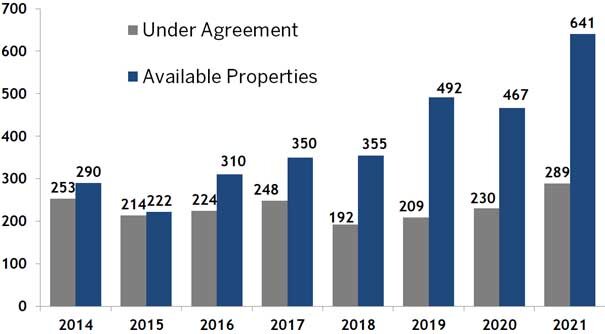
We're seeing an increase in residential sales activity in the core downtown Boston market right now. Year to date as of February 21, the number of properties going under agreement is nearly 16% higher than in 2020.Reasons for the increase in sales could include pent-up demand, low interest rates, and the increase in inventory (leading to more choice and less competition for properties you might make an offer on).As of mid-February, downtown Boston inventory of condos and single family homes combined is 37.26% above last year at this time. The chart below, from my latest Boston real estate market report, illustrates the rising inventory in recent years. The current availability of downtown Boston condos and homes is the highest it's been since 2011.
Higher inventory may be due in part to people who were going to put their properties on market in the spring of 2020 and postponed it until now. And some of the current sellers may be part of the uptick in number of people making a move from downtown to the suburbs.For more details on the downtown market, here's my latest report.If youhavequestions about buying or selling Boston real estate, please call me at
617-584-9790, or send me an email via the link below.
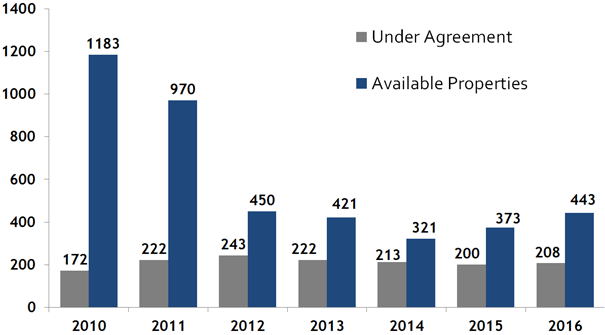
#BostonCondos #BostonRealEstateYou might be tired of hearing me say it, but it's still true. If you've been thinking of selling your Boston home or condo, this isa good time!Thegraph above showsthe number of Boston residential units that wentunder agreement for purchase (in grey) in the 30-day period ending September 15, 2016. It also shows how many listings were available (in blue) at the end of that period.You can see that this new phase of low supply began in 2013. It has remainedlow every year since then. The norm prior tothen looked more like what you see in the year 2011.Comparing the numberof properties going under agreement withthe number of properties available, we get what is calledtheabsorption rate. The rate is considered in terms ofmonths of supply. Most analysts consider a three-month supply to be a balanced market. When supply is low, there's upward pressure onprices. For the last year or more, Boston has been hovering roughly between about a 1to a1.4 month supply. In mid-September, it has bumped up toa 2.13months supply.This little bump in inventory will likely mean a bitless competition for buyers. That said, its still a historically low inventory of Boston condos and homes, making it a great market for sellers. If a property is 1) priced correctly, 2) shows well, and 3) is well-located, it can go under agreement very quickly for favorable terms.I always like to emphasize how its still very important to price it right from the start, no matter what the market is like. When I list yourhome, my goal is to capitalize on the motivation of serious buyers, and those are the buyers who will visit the listing within the first couple of weeks it is on market. Iwant to make sure youll get them through your front door.Pricing your Boston home correctly isone of four vital components to selling with a good outcome.An experienced broker who knows the market well willhelp you to 1) understand the value of your home in the marketplaceand how to price it, 2)expose your home to the widest possible group of qualified buyers, and 3) show and represent your home in the best possible light.Most importantly, a trusted brokercan give yousound guidance through the potential pitfalls that can, and do,derail real estate transactions.For more than 24 years, I have helped people buyhomes and condominiums in Boston and its suburbs.I have developed anextensive knowledge of the many issues involved in the local real estate market.Ifyouhave been thinking about selling your Boston home or condo, or have questions about buying or selling Boston real estate, pleasecall me at
617-584-9790. Or email me with a click ofthe blue button.