Boston Real Estate Market

Why Moving to a Smaller Home After Retirement Can Make Life Easier


Retirement is a time for relaxation, adventure, and enjoying the things you love. As you imagine this exciting new chapter in your life, it's important to think about whether your current home still fits your needs.

If it's too big, too costly, or just not convenient anymore, downsizing might help you make the most of your retirement years. To find out if a smaller, more manageable home might be the perfect fit for your new lifestyle, ask yourself these questions:

  • Do the original reasons I bought my current house still stand, or have my needs changed since then?
  • Do I really need and want the space I have right now, or could somewhere smaller be a better fit?
  • What are my housing expenses right now, and how much do I want to try to save by downsizing?

If you answered yes to any of these, consider the benefits that come with downsizing.

The Benefits of Moving into a Smaller Home

There are many reasons why you should downsize. Here are just a few from Bankrate:No Caption Received


Your Equity Can Help Make Downsizing Possible

If those perks sound like something you’d want, you may already have what you need to make it happen. A recent article from Seniors Guide shares:

“And at a time when homeowners age 62 and older have more than $12 trillion in home equity, downsizing makes sense . . .”

If you’ve been in your house for a while, odds are you’re one of those homeowners who’s built up a considerable amount of equity. And that equity is something you can use to help you buy a home that better fits your needs today. Greg McBride, Chief Financial Analyst at Bankrate, explains:

“Downsizing can mean taking that equity when the home is sold and using it to pay cash or make a large down payment on a lower-priced home, reducing your monthly living expenses.”

When you’re ready to use all that equity to fuel your next move, I will be your guide through every step of the process. That includes setting the right price for your current house when you sell, finding the home that best fits your evolving needs.

If you're starting your retirement journey and thinking about downsizing, let's talk. 

Joe

Welcome to 2024! Thoughts on Boston Real Estate Moving Forward


Welcome to 2024!

  • Interest rates are beginning to fall a bit, and it looks like the economy may be coming in for that soft landing. Look for interest rates to continue loosening somewhat . 
  • Buyer demand has been strong, and we think that will continue and even increase as folks get back into the market.
  • Supply has been tight, but we think that it inventory will increase enough to make a difference. As interest rates soften, we think more sellers will begin to consider their next move.
  • Prices will continue to increase, but possibly on a more predictable slope.
  • Tax relief in MA: $1B in tax cuts will provide a bit of stimulation to the real estate market.

We run our market reports every two weeks, so you can get an almost up-to the minute view of what's happening around town. Take a look!

Thinking about your next real estate move? I'm very happy to answer all of your questions and to assist you with the experienced guidance you need! joe.wolvek@gibsonsir.com (617) 584-9790 

Joe


How Inflation Affects the Housing Market


Have you ever wondered how inflation impacts the housing market? Believe it or not, they’re connected. Whenever there are changes to one, both are affected. Here’s a high-level overview of the connection between the two.

The Relationship Between Housing Inflation and Overall Inflation

Shelter inflation is the measure of price growth specific to housing. It comes from a survey of renters and homeowners that’s done by the Bureau of Labor Statistics (BLS). The survey asks renters how much they’re paying in rent, and homeowners how much they’d rent their homes for, if they weren’t living in them.

Much like overall inflation measures the cost of everyday items, shelter inflation measures the cost of housing. And for four consecutive months, based on that survey, shelter inflation has been coming down (see graph below):

Why does this matter? Well, shelter inflation makes up about one-third of overall inflation, as measured by the Consumer Price Index (CPI). So, when shelter inflation moves, it leads to noticeable moves in overall inflation. That means the recent dip in shelter inflation might be a sign that overall inflation could fall in the months ahead.

That moderation would be a welcome sight for the Federal Reserve (the Fed). They’ve been working to get inflation under control since early 2022. While they’ve made some headway (it peaked at 8.9% in the middle of last year), they’re still trying to get to their 2% goal (the latest report is 3.3%). 

Inflation and the Federal Funds Rate  

What’s the Fed been doing to lower inflation? They’ve been increasing the Federal Funds Rate. That interest rate influences how much it costs banks to borrow money from each other. When inflation climbed, the Fed responded by raising the Federal Funds Rate to keep the economy from overheating.

The graph below shows the relationship between the two. Each time inflation (shown in the blue line) starts to climb, the Fed raises the Federal Funds Rate (shown in the orange line) to try to get it back to their target of 2% (see below):

The circled portion of the graph shows the most recent spike in inflation, the Fed’s actions to raise the Federal Funds Rate to fight that, and the moderation of inflation that happened in response to that hike. As inflation gets closer to the Fed’s current 2% goal, they may not need to raise the Federal Funds Rate much further.

A Brighter Future for Mortgage Rates?

So, what does all of this mean for you? While the actions coming out of the Fed don’t determine mortgage rates, they do have an impact. As Mortgage Professional America (MPA) explains:

“. . . mortgage rates and inflation are connected, however indirectly. When inflation rises, mortgage rates rise to keep up with the value of the US dollar. When inflation drops, mortgage rates follow suit.

While no one can predict the future for mortgage rates, it’s encouraging to see the signs of moderating inflation in the economy

Bottom Line

Whether you’re looking to buy, sell, or just stay informed about the housing market, let’s connect. 

Sold! Back Bay 2 Bed 2.5 Bath Condo $2,625,000

I'm delighted, and so are my clients, that we were able to secure this elegantly appointed Back Bay 2 bed 2.5 bath condo with soaring ceilings on the river side of Beacon Street! The front parlor living room overlooking Beacon Street has a gas fireplace and custom built in cabinetry. The rear parlor dining/family room has a gas fireplace and sweeping Charles River views. There is elevator access for ease of living between floors. Renovations include new hardwood floors, new vanities, and elegant custom drapery.

See more photos and details for 484 Beacon Street, #1.

Are you starting a home search in the Boston area? Keep in mind that the seIler of pretty much every property you will see, whether it's a small condo, a brownstone home, a loft, or a luxury condominium, will be represented by an experienced, professional Boston Realtor. And you as a buyer should be, too! To help you understand how I work with my buyer clients, here's my Purchasing Overview.

You can view my recent sales and listings here.

If you have questions about buying or selling Boston real estate, please call me at  617-584-9790 or email joe.wolvek@gibsonsir.com.

My Thoughts on the Boston Real Estate Market

That’s when the Federal Reserve started tightening the screws, ending our sugar high of historically low interest rates in an attempt to get a hold on inflation. The post-covid-lockdown period has certainly come with a variety of challenges and uncertainty.

As we start to transition into this period, it’s worth asking what the housing market is transitioning to.

Do you think it could be...normal?

3% interest rates are certainly not normal. Having 50 buyers bid on a house is not normal (as nice as it was for sellers).

I’m not trying to say that high interest rates are a good thing.

But what, historically, is a high interest rate? 5%? 6%? Is even 7% a high rate? Not historically. Just for perspective, I’ve got folks in my office who laugh and tell me, “I bought my first place at 18%!” (BTW, that's most assuredly not normal either).

Here is a link to the history of mortgage rates over the last 50 or so years

Even at higher interest rates, the sky will not fall. Sellers will still be getting a nice return on their home. Buyers will not have to get into ridiculous bidding wars over homes. There is no bubble to burst.

Will a recession come? Maybe not tomorrow or even this year, but...Yes! They always do!

Here's my recession story: I bought my previous home in August of 2008. I paid $640,000. In 2010, in the middle of a historic economic meltdown, the unit next door to mine, essentially the same unit, sold for $575,000. In 2020, I sold my unit for $1.1m.

Let’s get a grip on what we have here in the Boston area: A super-strong economy with varied industries creating thousands of jobs. A vibrant city that is the envy of most of the rest of the country.

Over the last decades, Boston real estate has been a super investment.

Even in the 2009 meltdown, we saw minimal losses and a vibrant recovery. At this time, our market is much healthier. Home equity far surpasses what it was then. The average credit rating of current mortgage borrowers is significantly higher. The structural problems in the mortgage industry have been mitigated to a high degree.

And one more thing: Inventory. Levels of inventory here over the last 20 years or so have been low relative to most other markets. Absorption rates reflecting low levels of inventory, the envy of most other locations in the country, remain remarkably steady, even in relatively hard times, aside from a few spikes. As of June 15th, 2022, we had only 2.44 months of inventory in our downtown neighborhoods. For the same period of 2020 as we were emerging from Covid lockdown, we had 2.94. During 2009-10, they were higher, but nothing approaching the levels of unsold inventory we were seeing in other places.

If you just look at our neighborhoods in Boston, Brookline, Newton, Cambridge, Somerville, and our other local inner suburbs, you realize that there is little opportunity to build vertically (at least for non-uber-high-end housing), and there is virtually no room for sprawl (until you get to the more outlying suburbs). So for property owners, there is built-in value protection over the long run.

So long story short, "normalization" means that there will be less competition for properties (you may even score a great property without any competition!), and less sharp property value inflation. 

Here is the detailed market report for *all* Boston neighborhoods and inner suburbs.

If you have questions about buying or selling Boston real estate, please call me at  617-584-9790, or send me an email at joe.wolvek@gibsonsir.com

Increased Sales & Inventory in Downtown Boston Real Estate Market

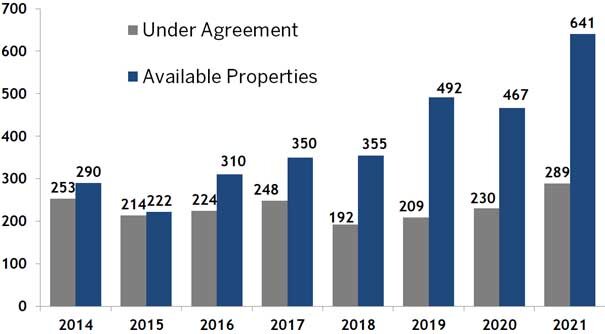
We're seeing an increase in residential sales activity in the core downtown Boston market right now. Year to date as of February 21, the number of properties going under agreement is nearly 16% higher than in 2020.Reasons for the increase in sales could include pent-up demand, low interest rates, and the increase in inventory (leading to more choice and less competition for properties you might make an offer on).As of mid-February, downtown Boston inventory of condos and single family homes combined is 37.26% above last year at this time. The chart below, from my latest Boston real estate market report, illustrates the rising inventory in recent years. The current availability of downtown Boston condos and homes is the highest it's been since 2011. Downtown Boston real estate market Higher inventory may be due in part to people who were going to put their properties on market in the spring of 2020 and postponed it until now. And some of the current sellers may be part of the uptick in number of people making a move from downtown to the suburbs.For more details on the downtown market, here's my latest report.If youhavequestions about buying or selling Boston real estate, please call me at617-584-9790, or send me an email via the link below. Boston real estate 

Boston Real Estate: Where to Live in Boston

South End Boston real estate#BostonCondos #BostonRealEstateAre you thinking about where in Boston you'd like to live? Do youprefera neighborhood that is quaint, charming, and close to parks? Or maybe one that is modern and neartheatre productionsand plenty of fine dining options? Or maybe something else, but you're not sure what? Boston is a city with an eclectic range ofdistinctive neighborhoods to choose from, each having its ownpersonalityand feel. And because the city is so compact, most downtown neighborhoods are not that far apart from one another. If you're considering which neighborhood might suit you best, you may want to start with my Where to Live in Boston overview.You can see more about some of theindividual neighborhoods, including condos and homes for sale in them, at my South End, Back Bay, Beacon Hill, Midtown, Leather District, Waterfront, Seaport, South Boston, and Fenway neighborhood pages.Are you planning a relocation to Boston?If you're lookingfor a home in a luxury residential building, there are many excellent options in the heart of the city.Many are high-rise buildings,while some are smaller and boutique-style. The majority of theseluxury buildings haveelevator, central air, and full time conciergeservice. Almostall have garage parking,sometimes by valet, and many also havehealth clubs, catering kitchens, andentertaining rooms on site.If you have any questions at all about buying or selling Boston real estate, please get in touch!Call me at617-584-9790, or send me an email using the blue "Questions?" button below. In my23+ years working with the Boston real estate market, I have made it a priority to buildan extensive knowledge of Boston, itsneighborhoods,buildings, people, and of course the issues that are involved in the local real estate market. Boston real estate 

Boston Real Estate Headlines:

Featured Boston Real Estate: